SENSEI
Those who made the road before
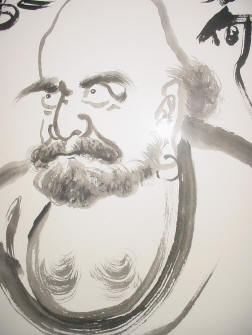
Bodhidharma (470-543)
INDIA
Based on mans' instinct of self-defense, different fighting arts were developed in most cultures, especially in central Asia, Egypt and Turkey. The principles of the Asian martial arts are believed to have spread from Turkey to India, where they were further developed to sophisticated arts ("kalaripayt").
The history of Karate as we know it today can be taken back to India, perhaps two thousand years before the Christian Era. India was the birthplace of a bare-handed martial art called, in Sanskrit, Vajramushtthi. Evidence seems to indicate that it was commonly practiced by the Kshatriya, which was the Warrior Class of that time, and which can be compared to the Japanese Samurai and the medieval Knights of Europe.
It is said that the third child of King Sugandha of southern India was a member of the Kshatriya (Warrior) Caste. However, after a few years he was led by the spirit to a small but dynamic Buddhist province south of Madres. He received his religious training from the Dhyna of Master Prajnatara. Under the master's guidance, the boy grew into a very wise man and advanced in the way of the Dhyana or Buddhist practice, and was given the name Bodhidharma. "Bodhi" means Enlightenment and "Dharma" means law.
CHINA
After his masters death, Bodhidharma traveled to China, where he taught. His life was centered around the Shaolin Temple and monastery located in Hunan Province. Tradition states that upon seeing the emaciated condition of the monks, Bodhidharma instructed them in physical exercise, to condition their bodies as well as their minds. The exercise was called, "Eighteen hands of Lo-Han". This exercise also included breathing; he knew that this physical activity was a means of cleansing body internally. Eventually the monks began to study the animals and form exercises that resembled their ways of fighting, and later it was known as Chuan-Fa, "The Art of the Fist". It is important to note that the motives of the practice was art, physical conditioning, and finally, self-defense.
During the Sui Period (589-618), bandits began to raid the monastery for the purpose of food and anything of value.
At this time the monks, in order to protect their lives and their beloved monastery, utilized their Chuan-Fa art and defeated the bandits. The reputation of the Shaolin Fighting monks spread, and many came to study the art along with Buddhism. Today there are hundreds of styles, and of course the philosophy has changed somewhat, depending on the personality of the headmaster of the styles. In 1609 the art was brought to Okinawa where it underwent many changes and became later known as Karate-do.