SENSEI
Those who made the road before
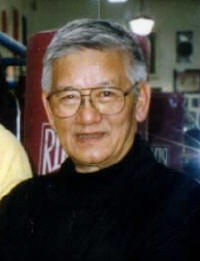
Dr. Maung Gyi
American Bando Association
I have known Dr. Gyi since before safety equipment was even in the mind of its inventor, Jhoon Rhee's. Bare hand and feet were the norm, with no contact rules. At the time I thought my students were the only warriors but to my surprise, Dr. Gyi's team was very proficient.
Dr. Gyi began his training even before myself, about 50 years ago. During these times any tournament, if you could find one, featured demonstrations by the head of each group. Breaking was a major part of these meets. All breaking followed the hard material breaking practice; concrete, wood, cinder blocks, ice, etc. Dr. Gyi caused me great mental anguish by breaking an item that I could not – a simple child's balloon, a feat that I could not duplicate until recently. Dr. Gyi would punch the balloons with his closed fist breaking the balloon on contact.
Dr. Gyi is a true gentleman of karate. The following biography was part of Dr. Gyi's induction in to the Okinawan Isshinryu Karate Hall of Fame, hosted by George Iberl. This does not do him justice in my opinion but is as much as you could get from a very humble Dr. Gyi.
~HGS
SHORT BIO
Grandmaster Dr. U. Maung Gyi, was born in Mandalay, Burma, the son of the late Grandmaster U Ba Than Gyi. Dr. Gyi has studied Bando and other martial art systems from numerous masters. Notably among his teachers were Grand Master Genju Bahadur, a Gurkha warrior of the first and second world wars, and Gogen Yamaguchi, often referred to as "The Cat", of Japanese Goju Ryu.
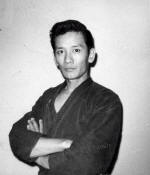 As a follower of Bando, Dr. Gyi does not limit himself to any one
martial art. A master of both the empty hand and weapon hand, he has
studied Kempo, Isshinryu, Shaolin, Judo, Aikido, Jui-Jitsu, Tai Chi
Chuan and western boxing.
As a follower of Bando, Dr. Gyi does not limit himself to any one
martial art. A master of both the empty hand and weapon hand, he has
studied Kempo, Isshinryu, Shaolin, Judo, Aikido, Jui-Jitsu, Tai Chi
Chuan and western boxing.
Dr. Gyi has founded the American Bando Association (ABA) in 1960 in Washington, D.C.
The ABA is a non-profit World War II Memorial Organization to honor the veterans of the China-Burma-India (CBI) Theatre of W.W. II, the Korean War and Vietnam War; to pay tribute to the 1st Burma Gurka Rifles (and the 10th Burma Gurka Rifles 1890-1946); and to preserve the combative arts practices in Northern Burma, Southwestern China and Northeastern India during W.W. II.
The ABA holds three events annually on Memorial Day, VJ Day and Veterans Day.
INTRODUCTION TO BANDO
Bando is a Burmese martial art.
History:
Despite the Chinese influences, Bando is credited as a style of armed and unarmed combat native to Burma. It is an assimilation of Karate-like striking and kicking techniques, Judo-like throwing techniques, swordplay and fighting with knives, spears and sticks.
There are numerous interpretations of the term Bando, and different linguistic and ethnic groups hold to diverse translations. It is generally interpreted in three ways:
- "way of discipline"
- "systems of self-defense"
- "art of fighting or combat"
Some Bando groups have combined all three translations in one, making it similar to the Japanese term Budo (stop conflict), the Chinese word Wu Shu (war art), or the English terms military arts or martial arts. Some etymologists believe the term Bando derives from Chinese, while others claim Indian or even Tibetan origins. Bando is also called "Thaing."
There are many styles of Bando, but most follow basic instructional patterns. The art emphasizes initial withdrawal followed by an attack outside the opponent's reach. All parts of the body are employed in these attacks, and once the initial technique is delivered, grappling and locking techniques are used. Techniques are learned first through formal exercises in some systems and only later through sparring.
When the Japanese invaded Burma in 1942, they encouraged the practice and proliferation of Bando and influenced it by exchanging techniques from Judo, Jujutsu, and Aikido. After World War II, Bando was furthered through a large number of competitions.
Bando was introduced in the U.S. by Dr. Maung Gyi, a college professor who began teaching the art on April 3, 1960, in Washington, D.C. Later, Bando classes were formally conducted at American University until the fall of 1966. Dr. Gyi organized the American Bando Association on June 15, 1968, at Ohio University. Members present at this initiation ceremony took a blood oath.
The International Bando Association was officially formed on March 9, 1946, by U Ba Than, then director of physical education and athletics for the Union of Burma. The IBA was organized in honor of those servicemen who fought and died in the China-Burma- India theater of World War II.
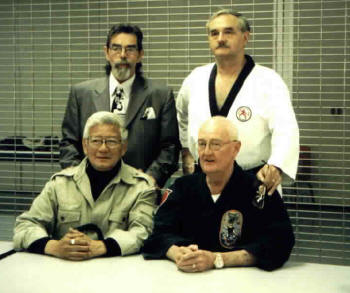
Standing: George Iberl (left) & Harry G. Smith (right)
Seated: Maung Gyi (left) & Ed Mc Grath (right)