TATSUO SHIMABUKURO
1908-1975
Just a human being, just a man
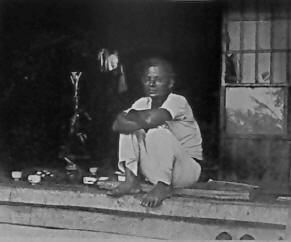
I have read so many biographies describing my Master that I would not have recognized him had he actually been as the biographies describe him to be. I have yet to read anything actually written by Sensei's family or even close friends.
Those who actually have a very real desire to know of him are forced to rely on the words of others. I will not attempt to put to paper all of the exact statistics of his life, but I will do the best I can with what I have, my memories.
Tatsuo was many things in his life, farmer, construction worker, businessman, and above all a family man, definitely not one to run and hide from Japanese invaders. I just do not think that I have the right or ability to try to understand or write about his personal actions and feelings; he was not a public person, again, at least as the Sensei as I knew him. I do not think anyone has the knowledge of how Tatsuo actually was able to perfect a system that, if left in it's original state, would have been unconquerable.
The Dojo:
Before I tell you about Sensei as I knew him, I will, to the best of my ability and memory attempt to set forth how the dojo functioned and how Sensei taught.
Unlike today, in those days the responsibility of cleaning the dojo was left to the student and not the Master. The USMC rank pecking order carried itself over to the class and lowly PFCs were designated to do the dirty work, naturally at the time I was a PFC as was Art Smiley. Nagle and Hall were sergeants, Long and Keith were Staff. In Kyan (chun), raking leaves and cleaning up animal dung was the norm. When the move was made to Agena we carried cinder block and mixed cement by hand, not machines.
When I left Okinawa we had the walls up to 9 courses of cinder block and the gate in the far wall was framed out but not lettered or finished. The binjo( bathroom) was still just a hole in the ground, right next to the kitchen.
Training:
As far as training goes, here again believe it or not, I had permanent mess duty from 7pm to 4am for about 6 months, if I remember correctly. This allowed me access to the dojo during the day. The other times we went after work and on weekends. Keep this in mind if you are not service orientated. The Marine Corp has the same standards as you do when there is no war going on or no operations planned. This means every man went to work every day for 8 hours, no exceptions. Higher ranks had less leeway than lower ranks because they had to supervise the lower ranks.
The only persons there during the day were Art Smiley and myself. We spent the majority of the time fighting and in the early evening hours when others were there we did kata. Those students who knew more than the other taught kata. Art Smiley taught Harold long and I didn't keep track of the others. Sensei would sit on the step and just watch. When a mistake was made he would stop me and correct the move, explaining exactly what I was doing.
As time went by I began teaching students just as I had been taught. Sensei always made sure all moves were the same.
The Charts:
The charts on the wall, three of them, had a stick figure with what the stick figure meant. The three charts were the Kata Chart, Chart One and Chart Two. The charts on my dojo walls today are the same with the exception of the stick figures.
Sanchin was taught first and then again last, following the Eightfold Path of Zen Buddhism. We had a kata called Kusanku Sai as a weapons kata, was the same as Kusanku with no kicks and a kata called Boo.
The exact order was Sanchin, Seisan, Seiunchin, Naihanchi, Wansu, Chinto, Suansu, Kusanku, Kusanku Sai, Boo and Sanchin.
Different persons spell these kata different. Note the spelling of Suansu and Boo.
Most Sundays we would explore Zen breathing techniques and the like, but in those days Zen, the word itself, was meaningless to me. Sensei would sit for hours and explain what we were to be thinking.
About ranks:
Now is also the time to say that we did not know anything about rank, its designation, nothing. You were a black belt or nothing. If a demonstration came up Sensei would hand out different colored belts to different people. One demonstration a man might be a black belt, the next brown. At the dojo most times only gi bottoms were worn. Only those who had no definition or signs of muscle tone wore tops.
Today's students know more now than we did then. I do not care if you were Harold Long, Don Nagle, AJA, Harry Smith, or anyone around 1959-60, no one understood the rank system, no one.
Kata:
As far as what a kata name meant it was just used by Sensei to designate what kata he wanted to see. He would then say what kata but never told us what the kata name itself meant. I find it hard to believe that in the space of just eleven months after I left, the entire Isshinryu system became streamlined with all the goodies, I just do not believe it. Fancy plaques instead of stick figures, names for everything, fireside chats, Sensei going from not speaking English to being able to sit down and give verbal explanations and descriptions to students. No, I do not believe it. If he could do all that in 1960, why then did he bring an interpreter with him when he visited the United States?
Makiwara:
We had two makiwara stands, a platform with one post higher on one end and another post lower on the other end. One platform was about 8 feet in length and the other was shorter. This was used for three purposes. It had a punching pillar and a kicking pillar. The third purpose was to teach retraction. The platform with the pillars closer was used in such a manner that when the forward post was hit with the fist you immediately thrust the same punching elbow backwards toward the rear lower pillar. This caused a retraction action somewhat like snapping a towel. We had no other training apparatus in the dojo at that time.
Vietnam:
Training was much different when I returned to Okinawa for training during Vietnam. You can read about this at this site at the section called "History of Phoenix". Actually, these are some excerpts from another book I wrote and that is still gathering dust somewhere.
Sensei:
Tatsuo Shimabukuro, I use this spelling of his name as this is how my diplomas are signed, was born on September 19, 1908.
This spelling is also used by his Okinawan family and the Uezu family. Many will notice the way his name is written and wonder what's up. This would include me up to not long ago. It is my understanding if you are writing an Okinawa you would write Shimabukuro Tatsuo, Sensei, this so as not to confuse Okinawans. If you were writing others you would write Sensei Tatsuo Shimabukuro.
For your thoughts: I have been called many names, the strangest, Great Grand Master, then comes Grand Master, then Shihan, I think, then Master. Sensei called me Ronin. Had not a clue what that meant. I also have been called many less flattering names but then again this is not my biography. I use Sensei as I would use Mr., much safer.
I believe Sensei was about 48 years old when I first met him. I never had the nerve to measure his height, so I'll put it as around 5 ft., with his weight being around 130lbs. He was a very slight man. Sensei always wore either gi bottoms and a T-shirt or a white dress shirt with khakis and always the Gitas (sp), a type of slipper.
I do not believe that Sensei had a master plan as far as Isshinryu goes. I think he probably was surprised that his teachings did indeed extend as far as it did during his lifetime, but that's a story for later in this bio.
Sensei could speak no English, and at the time there were very few fireside chats between him and his students but then Sensei was a master of Mondo. He had the ability to paint pictures in my mind that did not allow mistakes or misunderstandings. Every move in the kata was put to physical application in order that there would be no chance of "watering down" or innocent changes made by other students.
His method of teaching in the later days was to use advanced students to teach beginners. In the early days, there were no advanced students to teach so when a student was taught something it was up to the student to study the moves. Sensei would sit and pound his knuckles and watch the training, only to be very loud when a mistake was made.
Physically speaking, Sensei had great coordination, and inner strength. His ability to climb up a pole feet first and come down head first hardly winded him, except one time when he got caught in splinters and had to rely on a sign to get down. The photo I have of him was taken during that minor accident. Sensei, at least whenever I saw him, never ever actually drove a nail through a piece of wood. He did use his hand as if using a hammer, and pounded the nail many, many times until it became lodged deeply in the wood. He also kept time by striking anything. We found this out by questioning how he knew when Sanchin should be completed. He would hit a nail or board or rock just enough times to match the seconds it took to complete Sanchin.
Besides American students we had Okinawans, one of them being Kichiro Shimabuku, Tatsuo's son. He was about 15 at the time. He also had a younger brother Shinsho. I never trained with Shinsho and I cannot understand how, in 1958 Kichiro was at the dojo training, no site of Shinsho, especially in Agena, yet in 1959 Shinsho was a black belt training marines.
When it came to being paid, Sensei would make any kind of deal. Harold Long and Dick Keith paid their dues in sugar and commissary, food stuffs from the base store. Hall and Nagle were good friends and they both had connections to the chow hall. The stores there caught heck. It was Hall, who actually fixed it up for me to have permanent mess duty, 7:00pm to 4:00am. This allowed me complete access to the dojo during the day.
Philippines:
I believe now is the time to explain the innuendoes and comments regarding Sensei's dislike of the United States as well as the much disputed training of Japanese Royal marines in the Philippines. First of all, this subject would have never come up had not the story of Sensei hiding in the bushes from the Japanese appeared. This would have been so far out of character that it is laughable. I promised Uezu Sensei not to speak of this and I have thought long and hard about this. I have also read his reply to me over many times. Maybe I am looking for an excuse to praise Sensei, yes I mean praise. Some of you frown on something like that and there are some, in fact a lot of people, who frown on the Phoenix program. Both were necessary evils.
A reasonable explanation regarding the last paragraph; remember I am trying not to offend or embarrass anyone but keep that in mind, I wrote Uezu Sensei in an attempt to confirm two things. First, his dislike of Americans as well as his training in the Philippines; his reply was very harsh, denied everything, threatened to expel me from Isshinryu, cut off my connection with Okinawa, if I remember correctly. I posted this because all his letters to me had his seal and his secretary writes all letters from Uezu Sensei at the time. When Uezu Sensei wants to talk he sends a tape. Only two letters did not have his seal, the one denying the above and another where he called the first generation "Saki Dans." Neither has his seal.
Sensei did, and verified by Chris Thomas, of Black Belt Magazine, went to the Philippines in 1939 and remained for two years, confirmed this. The Japanese were in the Philippines at that time. He then traveled to Tokyo where he remained until 1944. He then returned to Okinawa to get his family and take them to Kyushu, Japan where he worked as a farmer. In 1946 he returned to Okinawa.
I later, or earlier, wrote Uezu Sensei, got a different secretary, Tony Herald. Tony asked Uezu Sensei if Shimabukuro taught CIA operatives at a base in the northern part of the island. I forget the town location but it will pop up in one of my stories. Uezu Sensei confirmed that Shimabukuro did, in fact teach there although he would not speak of it to Tony. With that statement you can view Tony's reply on site or just ask Tony, he now has a dojo in Florida.
USA:
Sometime in early 1960 two men, William Duessel and Harry Acklin, who lived in Pittsburgh, traveled to Hershey, PA to entice me to travel to Pittsburgh every Saturday for $50.00. At a distance of 400 miles every weekend, money was definitely never the object.
Some of my best fighters came from that school. There were some that were more interested in kata than kumite. In those days kata was not my favorite thing. The trouble with this type of thinking was that I did not and would not rank unless a student performed according to his rank. This caused major bad feelings when I promoted a student to Sho Dan, and stopped there, that and at the time kata was not a very good strong point of mine and I disappointed men who deserved better. I can still remember to this day Joe Pennywell asking me almost every time we met "Is this the true way?" Yes, it was Joe, at the time I just did not understand your thoughts and question.
These bad feelings escalated into very serious discontent, causing the men who were interested in kata to seek another source of training, namely a benefactor, James Morabeto, who had money but absolutely no knowledge of karate or the respect due to Sensei.
In 1964 Morabeto would not spend money to house Sensei properly and gave him a small room in the basement of his home. For the working hours of every day Morabeto and these two men worked their regular jobs, leaving Sensei alone in that house with three women, the wife and two daughters of the pizza maker.
A most important fact here must be placed. Without Harry Acklin or Bill Duessel, Tatsuo Shimabukuro might never have visited the United States.
When Sensei was at Morabeto's home I was invited to meet with Sensei. When I entered the dining room Sensei was sitting at a large table surrounded by novice students, none of whom I knew. I had to stand at the other end of the table and just say hello. I never had a conversation with Sensei. The only contact I had was Harry Acklin repeatedly telling me to show Sensei a photo I had of Sensei's daughter.
As I stated so many times before, Sensei could not speak English, had no idea of what a proper bathroom was and had the normal, for an Okinawan, attitude regarding sanitary things and a woman's place in the household. What probably put the icing on the cake was when Sensei refused to close any door, bathroom, and bedroom when using, no matter what. Can you imagine the uproar when he used the toilet with three women watching?
When any food was served, never any attempt to please Sensei, the food was described by making sounds to match the food. The women would identify the food by making sounds such as "moo" for beef, "baa" for lamb, and so on. Sensei did not eat pork so they disguised it and then told him with an "oink, oink" what it was. Disguising food was very easy, as Sensei was under the weather most of the time. Hardly ever any vegetable as it was a starchy household.
In 1966 when he went to Washington State he was also under the weather most of the time. The women who disrespected him contaminated his rice. After all, American women frown on strangers using your bathroom with the door wide open and walking around all day half-naked. Here again, he should have had his own life while being left alone. He was bored and left alone for many hours each day as, and rightly so, everyone had to make a living, to work. He was also worked to death.
When he wanted to go site seeing he was denied this. He wanted to see the mountains of the United States. He never saw any close up.
When making the film of the kata he was totally disinterested, bored, and unconcerned. He went through the motions. Okinawa is using this film as gospel and there is no way to understand the Bunkai by one who was not there.
The ironic part of this story is that there just never was any respect paid to Sensei, and I believe that they just did not know any better, that or they were just plain ignorant.
Testing:
Sensei had a habit of testing some men outside the dojo and only one time did I know of it backfiring. I write this for the man who stood back and allowed hot tea to be thrown in Sensei's face. Yes, he was being tested and the test failed, branding himself a coward and Sensei insulted.
Karate movies:
Here I will put a bit of information that some will scoff at, some will accept, and some will laugh. No matter what, it is the truth, believe it or not. If you really want a picture of what Sensei was like all you have to do is watch one of the karate movies, keep forgetting the name, but John Claude Van Damme was the star. The story was about a master taking his student to a bar and instigating a fight, just to see how his student functioned.
Now the part that that will cause comments and speculation.
During one of the crazy occasions in my life I had plenty of spare time to write a story about Sensei. I had no actual point of reference to send the story to so, since the library had nothing but magazines, I located an address for a Chuck Norris dojo in Las Vegas, sent them the story line, and never received a reply. This same story came out in later years in the movie I referred to.
Naturally, it had additions and changes but never the less the story line was the same. And another thought I just had is that maybe my story was never ever given any consideration. Maybe someone else who knew Sensei wrote the story for I do not feel that I was the only person he did this to, maybe whoever wrote it is reading this right now and laughing at me for having the nerve to expect anyone to believe it.
As I wrote earlier I know of one man who failed miserably and I know there was some other man who referred to the tea incident on Sanchin.com but he never came forward and identified himself.
Koan:
We will be using a method of presenting to you information such as how a koan is used. Certainly not even close by comparison, but as a koan, all information, including this biography will be designed to make you think and to be able to think you must have an open mind.
There is absolutely no way I can describe the events in my Master's life, as he was born, lived, and finally died. Not very many marines were blessed with an interpreter to have thoughts and ideas transferred to them by a third person and as is all information passed through a third person, the information is subject to the whims and beliefs of the translator. It must be accepted that Tatsuo Shimabukuro could not speak a lick of English, just key words, between 1956 and late 1958.
If he could speak English after that date I would consider it a miracle as I, Harry Smith, think he had no interest in learning. On his visit to the United States he also had an interpreter with him.
By the same token I, myself, have never had the inclination to learn the dialect spoken by my Master. I felt, at the time, and even now, that I should spend more time perfecting what was taught, instead of what its meaning was.
One thing above all else, even his mastery of Isshinryu, he was an expert in Mondo. Mondo is the technique of transferring information between teacher and student using mental and verbal questions and answers.
Original Isshinryu:
When I speak of "Original Isshinryu" I will be speaking as taught to me by my Master, Tatsuo Shimabukuro. My tour of duty the first time was extended six months, giving me only about 18 months training. During this time period the original students consisted of Art Smiley, Don Nagle, Harold Long, Richard Keith, Kichiro Shimabukuro, son of Tatsuo, Eiko Kaneshi, Kiyoshi Iguchi, Ekiei Maekawa, and Kenji Kaneshiro. The preceding names are either nick names or as best described.
In my circle of classmates Don Nagle was the first to leave, then Harold Long, Richard Keith and Art Smiley. Up until I left in late June of 1958 I never met or trained with or even made contact with Steve Armstrong, Arsenio Advincula or any other ranking Isshinryu karate ka other than those previously named.
You must take note that Sgt. Hall, also one of the original class, was a mess hall (place where we ate) ranking NCO. He and Don Nagle ran the mess hall. It was he who kept me on night mess duty for his period of service and it was also through his intervention that I remained on this duty even after he left.
This is why you will note that the majority of photos taken of my Master and myself show no other students. The prime time for many students, even the original class, was weekends and about two nights a week. I know that much is written about all the hours others spent training, but it just wasn't so. All senior NCO's had jobs or assignments that demanded they work eight hours a day, much like Vietnam, where some units actually locked up the rifles after 5pm.
I was awarded my sixth Dan on May 22, 1958. As a matter of record, no matter what anyone has read in any article, not one Marine, myself included, even knew what "Dan" meant, much less 6th Dan. The only explanation I ever got was that I must train ten years before I would be ranked again, not much of an incentive to continue working out if you didn't know what "Dan" meant to begin with.
~HGS