WILD GEESE
A synopsis of Wild Geese
It was 1691 and the time of the October moon. General Sarsfield's Irish troops, withdrawing from the siege of Limerick, made their way down the banks of the Shannon River. Exile under the French flag and service in the army of Louis XIV was preferable to a life under the English yoke.
Overhead the autumn skies grew black with the wings of a thousand birds, eager and strident, crying the coming hard winter. The defeated soldiers looked up and saw their meaning. Thereafter they called themselves the Wild Geese.
Such were the vanguard of the innumerable Irish soldiers who sought fame and fortune as mercenary soldiers in the continental armies during the course of the next two centuries. They fought in every great conflict from those days until the Great War. During the Boar war they sent two brigades to fight for the boars.
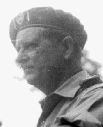
Colonel Mike Hoare
Commander of the Katanga Mercenaries
Better known as the Wild Geese
Operations Watch Chain, White Giant, and Banzai
The following is a brief synopsis of an era that probably rivals the Holocaust, at least as far as size of area to ratio is concerned. This information is covered extensively in Striped Moons, the biography of Harry G. Smith.
On New Years Eve, 1964, an army of very nasty men and young boys called Simbas, overran Stanleyville, the Congo, after the United Nations peacekeeping forces abandoned the many civilians not able to evacuate early enough. The Simbas fierceness and lack of compassion equaled and rivaled the Mau Mau of earlier atrocities. Their favorite method of killing was to make a nun drink gasoline and then cut her open and set her afire. Children were tied between two jeeps and torn apart. Crucifixion and castration were the norm. Only those who were there would understand what I am writing of. I believe this information was never made available to the public because the United Nations pulling out gave the Simbas carte blanche to do whatever they wanted to do to the population. The existing government was not able to organize their own army quick enough so the aid of Colonel Mike Hoare was instituted. These men, the Katanga mercenaries, better known as the Wild Geese, as in the movie of the same name, were split into groups to recover people still remaining in a very large area of the country.
In the case of this writers memories the group he is most familiar with is those men who rescued priests and nuns from the Wamba and Mungbere areas. In the course of this action the Didi oil refinery was also evacuated.
The Simbas were lead by a former railway clerk named General Olenga. His true power came from the control his assistant, Mama Orena, had over the Simbas. With drugs that made the Simbas hallucinate and a powerful method of brainwashing she was able to convince the Simbas that they were invincible. The Simbas would actually attack thinking they could not be killed. During the entire time span of this action and probably still today, a $50,000 bounty was placed on her head. She probably entered into the U.S. witness protection program, as the bounty has never been claimed.
Think about this page as you read letters and communications and especially if you ever read Striped Moons. True mercenaries are Patriots who are able to do what conventional armed forces cannot or will not do because of the control by which they must abide. I can guarantee you that those rescued thought their rescuers, the Katanga mercenaries, Gods.