SENSEI
Those who made the road before
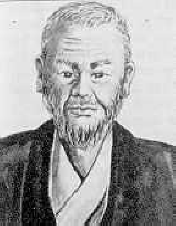
Yasutsune "Ankoh" Itosu
Isshinryu lineage: "Ankoh" Itosu → Chotoku Kyan → Tatsuo Shimabukuro
Yasutsune "Ankoh" Itosu, was born in 1831 at the village of Yamagawa, in Shuri, Okinawa.
At 16 he became disciple of Sokon Matsumura from whom he learned the basis of Shuri-te (To-de as taught in Shuri) and swordmanship (Jigen-ryu).
Being a scholar in the Chinese and Japanese languages he was secretary of the king of Okinawa until the fall of the monarchy in April of 1879. During this period he learned To-de (Okinawa-te) with other Masters of the time as: Kosuku Matsumura (of Tomari), Gusukama (of Tomari), Nagahama (of Naha) and Yasuri (disciple of Iwah possibly of Chinese origin).
From 1885 he decided to dedicate himself entirely to teaching To-de (Okinawa-te) and in 1892 he proposes the integration of To-de in Okinawa's education system.
In 1901 he introduced the practice of the To-de (Okinawa-te) as a physical education discipline in the primary school of Shuri.
In 1907 he created the five Pinan Kata (from the Kushanku Kata) and, in an innovative process, aiming at the adaptation of the To-de (Okinawa-te) to the educative system, he separates in three different katas the kata Naihanchi (later called Tekki by Funakoshi), and creates three versions of the following kata: Kushanku (Kwanku), Passai (Bassai) and Rohai.
His intense work on the adaptation and coding inspired numerous disciples and followers that originated important currents of modern Karate, such as: Gichin Funakoshi and Kenwa Mabuni.
However, other direct disciples of Itosu such as Kentsu Yabu, Chosin Chibana and Chotoku Kyan did not accept the deep changes that he proposed and tried to keep the warlike interpretations (Bunkai) of the original kata.
Other direct disciples of Itosu were: Choki Motobu, Chomo Hanashiro, Yabiku Moden, Shinpan Shiroma, Anbun Tokuda, Oshiro Chojo, Taoyama Kanken and Shigeru Nakamura.
Restless until the last days of its life Yasutsune Itosu died in 1915.