SENSEI
Those who made the road before
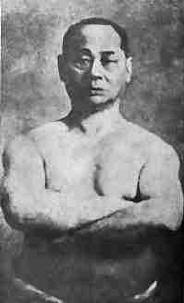
Choki Motobu
Isshinryu lineage: Choki Motobu → Tatsuo Shimabukuro
Choki Motobu was born on April 5th, 1870, in the village of Akahira, Shuri, Okinawa, being the third son of the governor of Akahira, Chomo Motobu, a descendant of Sho Shitsu, king of Okinawa between 1648 and 1668.
Choki revealed, since very early, an extraordinary physical aptitude being nicknamed "monkey" by the locals.
Since he was 12 years old he started to receive lessons in To-de (Okinawa-te) from his older brother Choyu, but his arrogant attitude (that took him frequently to physical disputes) brought him a bad reputation, and it became rather difficult for him to be accepted as disciple of local masters of To-de.
Thus, his progress was essentially self-taught, even if he received occasional lessons from Ankoh Itosu, Pechin Tokumine, and Kosaku Matsumora.
In 1921, when he decided to leave for Osaka in Honshu (the central island of Japan) his fame of fighter already ran throughout the Ryu-kyu territory. As soon as he arrived he became well knowned by challenging publicly and winning several combats with champions of Ju-jutsu and Boxing, and he became famous in the combat of November of 1921 in Kyoto, where he defeated George, an enormous and famous boxer.
Choki Motobu published two books that allowed him to divulge his concept of Karate to the great public: "Okinawa Kenpo Karate Jutsu", in 1926 and "Watashi no Karate-jutsu", in 1932.
Choki Motobu died in 1944.